When it comes to converting leads or selling products and services, trust is one of the most important factors influencing a potential customer’s decision. Being an expert in your field only goes part of the way to showing customers that they should choose your business. But, like they say, the proof is in the pudding. You’ve got to back it up with evidence.
Think about it. Who are you most likely to believe – the person trying to sell you something, or a satisfied customer?
And that’s where customer testimonials come in.
In this guide, we’ll cover the importance of customer testimonials, where to use them in your marketing to get the biggest impact, what you should include and the biggest benefits you can expect to see.
Looking for something in particular? Jump to one of the following sections:
What is a customer testimonial - and what’s the goal?
A customer testimonial is a statement from a past or existing client that highlights their experience with your business, product or service. It’s a form of social proof designed to reassure potential customers that you deliver on your promises.
The main goal of a testimonial is to build trust and reduce doubt. A strong testimonial should help a prospect see themselves in that customer’s shoes and feel confident that choosing your business is the right decision. That’s why it’s key to use a range of testimonials that exemplify each of your target user personas.
The importance of using customer testimonials in marketing
Customer testimonials are one of the most powerful forms of social proof you can use. At their core, they help bridge the gap between what your business claims and what customers actually experience. And in a world where buyers are bombarded with marketing messages on the daily, that distinction matters more than ever.
Recent research from Gartner aimed to uncover what the biggest influence was for buyers at the research stage, and found that 90% said some type of social proof, like testimonials, influenced their purchasing decision.
Here’s why testimonials make such an impact.
They reduce perceived risk
Every purchase decision involves some level of uncertainty. Will this product work? Is it worth the investment?
Testimonials directly address these concerns by showing that others have already taken the leap – and had a great experience. The more closely a testimonial reflects your prospects situation, the more effective it is at reducing hesitation.
They validate your expertise
Anyone can claim to be the best at what they do. With a testimonial, customers say it for you (which is far more persuasive).
When a client talks about specific outcomes of using your business, it reinforces your positioning in a more natural, authentic way.
They influence decision-making at key moments
Testimonials are great at the awareness stage, but they’re even better at the point of conversion.
Strategically placed testimonials can:
- Reinforce trust on landing pages
- Address objections on product/service pages
- Support pricing decisions
- Provide reassurance just before a call-to-action
Basically, they’re the final nudge that brings your customer over the line.
Older websites often become slower over time, especially if they’re built on outdated platforms, overloaded with plugins, or they’re sitting on underpowered hosting.
Beyond user experience, speed plays a role in search rankings as well. So not only is it a source of frustration, a slow site can actually reduce how many people find you in the first place.
They strengthen brand perception
Consistent, high-quality testimonials build a picture of your business over time. They highlight patterns in your customers’ experience – reliability, results, customer service, communication – that shape how your brand is perceived.
Over time, this creates a compounding effect: the more proof you show, the easier it becomes for new customers to trust you.
Getting testimonials from clients
One of the biggest mistakes businesses make when it comes to gathering client testimonials is waiting for them to come in organically. It’s very rare that a customer would approach you with a ready-to-go testimonial. In reality, most happy clients won’t even think to share one unless prompted.
Here’s a quick guide to asking customers for testimonials.
1. Ask at the right time
Timing is everything.
The best moment to request a testimonial is when the value you’ve delivered is fresh in the client’s mind, such as:
- Right after completing a successful project
- When a key milestone or result has been achieved
- Following positive feedback in an email or call
If someone has just expressed satisfaction, that’s your opportunity.
2. Make it as quick and easy as possible
The more effort required, the less likely you are to get a response.
Instead of asking, “Can you write us a testimonial?”, guide the client with simple prompts like:
- What problem were you trying to solve?
- What made you choose us?
- What results have you seen?
- What would you say to someone considering working with us?
You can even offer to draft something based on their feedback for approval – many clients appreciate this.
3. Be specific about how it will be used
Let clients know where their testimonial might appear, whether that’s on your website, social media, proposals, etc.
This transparency builds trust and makes them more comfortable sharing their experience. It also gives you explicit permission to reuse the testimonial across different channels.
4. Capture different formats
Not all testimonials need to be written. They can take the form of short written quotes, longer case studies, video testimonials and even audio clips.
Having a mix of formats gives you plenty of options for your various marketing channels.
5. Build it into your sales process
The most effective way to consistently collect testimonials is to make it part of your workflow.
For example:
- Add it as a step in your project completion checklist
- Include it in your CRM or client follow-up process
- Automate requests through email sequences
This means your testimonial library will grow naturally over time, rather than having to scramble to create something last minute.
How to use client testimonials to grow your business
On your website
Your website is one of the most important places to showcase testimonials.
Use them strategically across:
- Homepage (to build immediate trust)
- Landing pages (to support conversions)
- Product/service pages (to address objections)
- A dedicated testimonials page (to showcase volume and consistency)
Our top tip? Place testimonials near calls to action for maximum impact.
In your sales proposals
Including testimonials in proposals can strengthen your pitch and build confidence during the decision-making process.
A well-placed testimonial that mirrors your prospect’s situation can help overcome last-minute hesitation and push deals over the line.
As social media posts
Testimonials make excellent content. They’re relatable, engaging, and reinforce your credibility in a natural way.
You can:
- Share quotes as graphics
- Post short video testimonials
- Highlight client success stories
In your cold outreach campaigns
Testimonials can significantly improve response rates when used correctly.
Here’s how to use customer testimonials for cold outreach:
- Reference a similar client or result
- Include a short, relevant quote
- Link to a case study or success story
This helps build trust quickly, even with people who have never heard of your business before.
On printed marketing materials
Don’t overlook offline opportunities – they add credibility wherever your brand appears. Testimonials can strengthen:
- Brochures
- Flyers
- Event materials
- Sales packs
Real examples of customer testimonials
Here are some examples that have featured across websites and campaigns we’ve delivered for our clients.
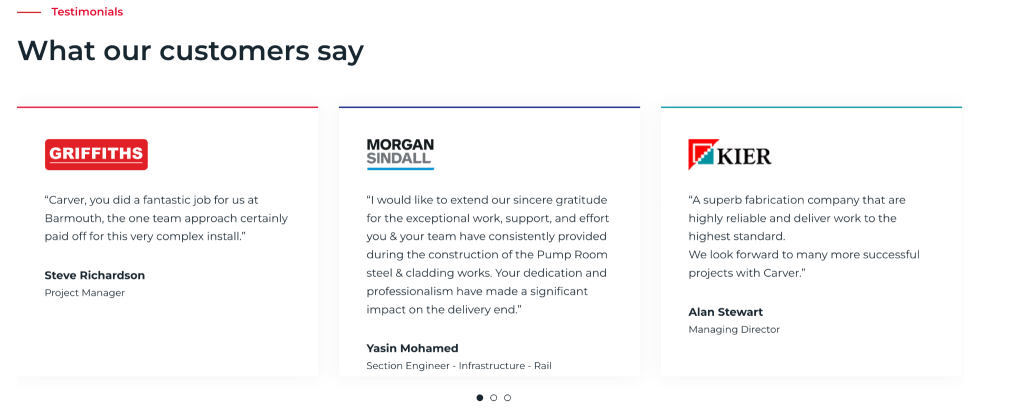
Carver Engineering
For Carver, we strategically placed a carousel of testimonials on their homepage, making sure to include the client’s name, job title and company where possible. To further strengthen this section, we also included the clients’ logos – a great option for B2B testimonials.
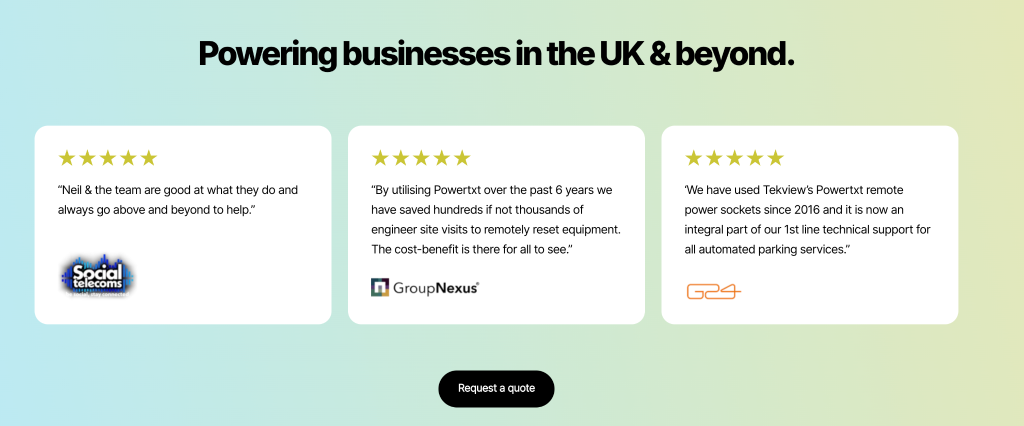
Tekview
For Tekview, we tried to include as many product-specific testimonials as possible on the relevant landing pages, followed by a call to action to ‘Request a quote’. Here’s an example on their product page for Powertxt remotes.
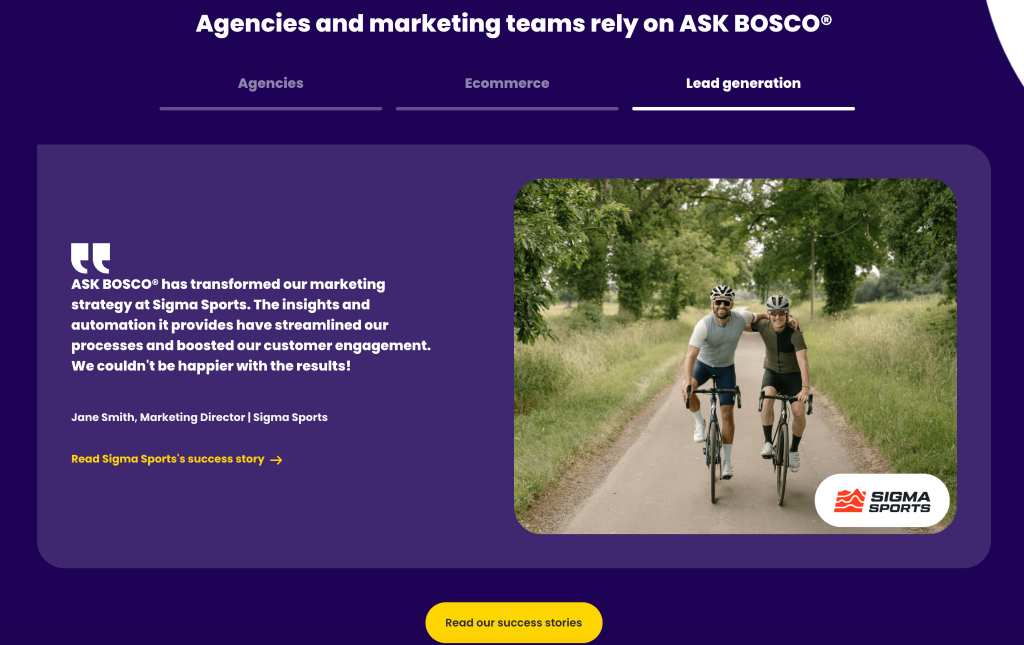
ASK BOSCO®
For ASK BOSCO®, we took snippets from longer case studies, providing the user with a link to read more – a great way to repurpose different types of social proof across your website.
Green Bros
Your website’s not the only place where social proof can improve prospects’ perception of your brand. Here’s an example of how a testimonial can work as part of your social media strategy too.

Making sure your testimonials come across as authentic as possible
Authenticity is what makes a testimonial believable (and ultimately, effective). If a testimonial feels staged, overly polished, or vague, it can do more harm than good. Here’s the advice we give our clients.
Use real, identifiable people wherever possible
The more detail you can provide, the more credible the testimonial. Ideally, you should include the full name, job title and company name of the person who provided the testimonial. Bonus points if you’re able to share a picture or video of them, too!
Focus on specific details
‘Great service’ and ‘highly recommended’ are nice, but a little generic. The strongest testimonials include the problem the client faced, why they chose your business, what the experience was like and the results or outcome.
Keep the original voice
It’s tempting to edit testimonials to match your brand tone of voice, but over-editing can remove the authenticity. Instead, let testimonials sound like the person who wrote them – natural language, imperfections, conversational phrasing and all.
Show a range of experiences
Not every testimonial needs to say the same thing, and nor should it. Try and choose ones that highlight different products of services, customer types or industries, or specific challenges your customers face. The variety helps more prospects see themselves reflected in your existing customers.
Keep them updated
Outdated testimonials can undermine your credibility, especially if they’re talking about old services or branding. Regularly refresh your testimonials to maintain relevance and reflect your current offering.
Are anonymous case studies and testimonials still effective?
While anonymous testimonials aren’t quite as effective as ones backed up by a real person, in some industries it’s necessary.
And they can still add loads of value. If you need to keep your clients anonymous, try to include as much context as possible to maintain authenticity. For example, share their industry or the problem you solved for them.
What are the biggest mistakes businesses make when using testimonials?
When used poorly, testimonials can hurt your brand or make you appear less credible. Here are some of the biggest mistakes we see time and again…
- Using vague or generic quotes
- Not updating testimonials regularly
- Overloading pages with too many testimonials
- Making them hard to verify
- Only showcasing “perfect” feedback (which can feel staged)
As with all aspects of your marketing, quality beats quantity every time.
Testimonials vs reviews: what’s the difference?
While often used interchangeably, there’s a subtle difference:
- Testimonials are usually curated, selected, and presented by your business as part of your marketing
- Reviews are typically left independently on third-party platforms and are less controlled
Both are valuable and can help sway prospects’ opinion. Testimonials help you shape your narrative, while reviews provide unbiased validation.
Final thoughts
Customer testimonials aren’t a ‘nice to have’ – they’re one of the most persuasive tools in your marketing toolbox when it comes to building trust and driving conversions. In many cases, they might even be the difference between a browser and a buyer.
When used strategically across your website, sales materials and campaigns, testimonials help show real results that back up your marketing claims – something that’s increasingly important to customers, who are becoming more and more aware of traditional marketing tactics.
If you’re not actively collecting and using testimonials, you’re leaving a valuable growth opportunity on the table.
To see how powerful an authentic and well-placed testimonial can be, check out some of our very own testimonials here, where you’ll find real feedback from clients we’ve helped to grow.
And if you’re ready to make your marketing work harder for your business, explore our full range of digital marketing services to see how we can help you attract, convert and retain more customers.
Share
Customer testimonials are just the tip of the iceberg
Want to know what you could be doing to get more leads for your business? From building trustworthy brands to results-driven marketing, we’re here to help you reach your goals.